Token price and stock price don't match: three kinds of gap
It's Saturday afternoon. You open the app and NVDAB is trading a little under what Nvidia closed at on Friday. Nothing has broken. The stock market has been shut since Friday evening, the closing price you remember is a frozen number, and the token is showing you what people will pay now for exposure to Monday's open.
That is one of three different reasons a tokenized stock and its share can show different prices. They look alike on a chart and call for different responses, so the first job is working out which one you are looking at.
Which price are you comparing with?
At any moment there are several "prices" for the same US stock, and comparing the token against the wrong one is the quickest way to see a gap that isn't there.
- The regular-session price. Live only from 9:30 a.m. to 4:00 p.m. Eastern Time on US trading days.
- Extended-hours prices. The platform's stock trading FAQ lists pre-market from 4:00 a.m., post-market to 8:00 p.m. and, for selected stocks, an overnight session; weekends are closed on the stock side from Friday 8 p.m. to Sunday 8 p.m. Eastern Time. Volume outside the regular session is usually much lower.
- The last close. What many price apps show when the market is shut. It stopped moving when trading stopped.
- The token's order book. bStocks trade on Spot 24/7, so this one never stops.
So step one is checking the US market's state right now: regular session, extended hours or closed. The market hours converter puts those sessions in your own time zone, and US market hours vs 24/7 tokens goes into when the token tracks the stock most closely.
Gap one: a premium or discount while the market is open
The bStocks FAQ is direct about this: a bStock's price "may differ from the price of the underlying security" and "may trade at a premium or discount". It lists the causes, among them supply and demand, liquidity, market maker activity, spreads, fees, taxes, corporate action processing, data delays and settlement constraints.
It also explains where the quotes come from. Spot liquidity is "supplied by multiple market makers, who price and quote based on a combination of underlying reference data, available inventory, and risk parameters". And the issuer side has its own channel: "Institutional participants who mint or redeem bStocks directly do so at prevailing market prices of the underlying equity through the Issuer."
The FAQ doesn't use the word arbitrage, and it doesn't promise that gaps close. What follows is our reasoning from those two sentences, not Binance's statement. While the US market is open, a market maker quoting off the live stock price, and an institution able to mint or redeem at that price, both have a reason to lean against a token that drifts too far from the stock. That is why the gap is usually small during the regular session. It also tells you when it can widen: when the stock isn't trading, when conversion is paused, or when quoting firms cut their size because risk has jumped.
Gap two: the market is closed
Overnight, on weekends and on US holidays, the underlying stock has no regular-session price. The token keeps trading. The FAQ says what happens to its price then: bStock prices "are determined by supply and demand on Binance and may move independently of the underlying equity's last close. Pricing is derived from Binance's internal reference price indices with multiple fallback layers."
Read that as: the weekend quote is the market's estimate of where the stock will open. If big news about the company lands on a Saturday, the token reacts first and the stock reacts at Monday's open. The open can gap straight past the token's weekend level in either direction.
Two habits we'd drop:
- Reading a weekend discount as a sale. It is someone's forecast, and it may be right.
- Using market orders on a thin weekend book. Fewer quotes mean wider spreads. We'd use a limit order at a price we chose, or wait.
"24/7 trading" means the book is open. It says nothing about how deep the book is, or about the price staying close to the stock. For what happens after you sell, see when you can use or withdraw the money.
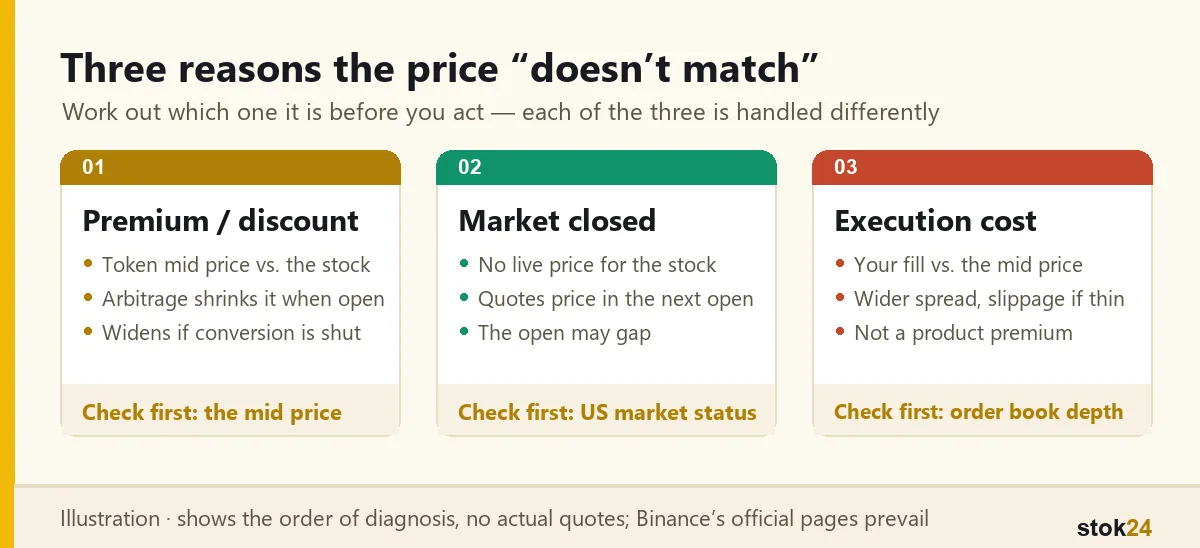
Gap three: your own fill
Sometimes the token's price is fine and the gap is in your order. Three numbers need separating:
- The mid price, halfway between the best bid and the best ask. This is the market's rough consensus on the token right now.
- The spread, the distance between that bid and ask. It is a cost in itself, and it widens as the book thins.
- Your average fill. A market order buys from the best ask upward until your size is filled. The bigger the order and the thinner the book, the further your average lands from the mid.
If your fill is well above the mid, that is execution cost. Check the mid price against the stock: if the mid is close to the stock, gap one and gap two aren't your problem, your order type and the book's depth were. The Academy guide's risk list has the line that fits this case: "Trading volumes may vary, potentially affecting your ability to buy or sell." It is about whether anyone is on the other side when you want to trade.
What the official pages leave out
Between the Academy guide, the two bStocks announcements and the FAQ, the mechanism is described in outline. Several things are not written down on any of them:
- how large a premium or discount can get, or how long one usually lasts;
- which firms act as market makers;
- how the internal reference price indices are built, or what the "fallback layers" are;
- the eligibility rules or limits for the retail conversion route.
The FAQ also says "The Issuer does not control pricing on secondary markets", and that on other platforms price is set by supply and demand on each platform. A bStock bought in a wallet or on a decentralized exchange can trade at yet another price.
Two claims to be wary of, then: "an oracle keeps the price pegged" and "it's backed 1:1, so the price equals the stock". None of the official pages we read describes an oracle peg, and backing is about whether a share exists behind each token, not about the price you get. The backing side is covered in checking 1:1 backing yourself.
Seen a gap? Sort it here
| What you see | Likely cause, and what to do |
|---|---|
| US market open, token clearly off the live stock price | Check your price source first: live, delayed or last close? If the gap is real, the forces that normally narrow it aren't working at that moment. We wouldn't treat it as free money. |
| Weekend or night, token differs from the last close | Normal. It is pricing the next open, and the open may gap. |
| Order filled well away from the price you saw | Execution cost. Look at the spread and depth, and use a limit order next time. |
| A sudden spike that snaps back | Probably one large order or a pulled quote on a thin book. Chasing it usually means buying someone else's exit. |
| A notice says conversion, deposits or withdrawals are paused | One of the routes that narrow the gap is closed. Expect wider gaps until the notice says it is back. |
The last row is where conversion stops helping. Per the FAQ's table of typical corporate actions, conversion is paused on a dividend ex-date and during splits and reverse splits, and those are exactly the windows where a gap can open up and stay open. We don't give timing calls on any stock or token; the product itself is explained in what bStocks are.
Sources, read 26 September 2026: Binance, Frequently Asked Questions on bStocks (updated 28 July 2026); Binance Academy, What Are bStocks? (updated 29 June 2026); Binance, What Is Binance Stock Trading and How to Trade Stocks on Binance? (updated 13 September 2026, for session times). Also read: the bStocks announcements of 11 June 2026 (updated 10 July 2026) and 13 August 2026 (updated 9 September 2026). How the internal reference price indices and their fallback layers work is Binance's description; nothing on the page lets us observe them.