Tokenized stock 1:1 backing: what you can check yourself, and what you can't
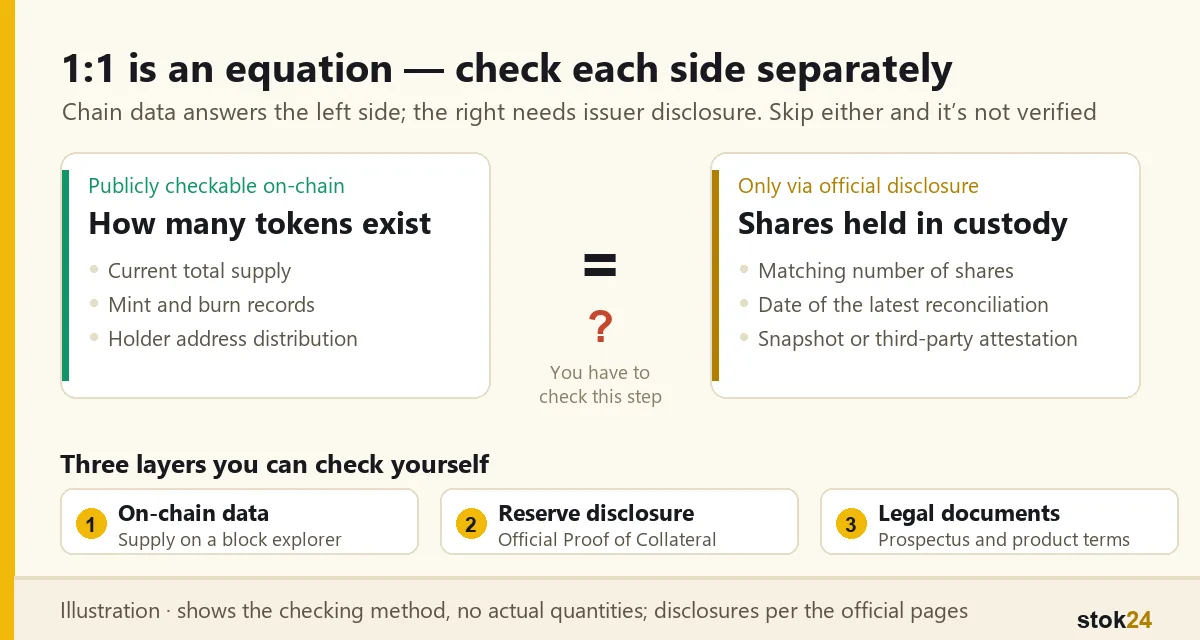
Two official pages describe the same backing in two different registers. The Academy guide says each bStock is "fully backed by a real US share held at a regulated custodian" and that this is "verifiable at any time". The bStocks FAQ says each bStock "is intended to be backed by a corresponding underlying security or other eligible assets". The second sentence is the one written with lawyers in the room, and it tells you how far your own checking can go.
This page splits the 1:1 claim into what you can look at yourself, what you have to take from the issuer's disclosure, and what stays blank. We read the pages below on 26 September 2026; none of it is a verdict on whether the backing is sound.
Who does what
Three roles sit behind every bStock, and it is easy to lump all three together as "Binance". Keeping them apart tells you whose promise you are checking.
- The issuer creates the token: BTech Holdings Limited, which the FAQ describes as a special purpose vehicle registered in Abu Dhabi Global Market (ADGM). Its obligations to holders sit in the prospectus and product terms.
- The custodian holds the shares. The Academy guide and the launch announcement call it "a regulated custodian"; the FAQ refers to custody arrangements "described in the applicable legal documents". None of them names it.
- The venue is where you trade and hold. The footer of the collateral page lists the ADGM entities: Nest Exchange Limited, Nest Clearing and Custody Limited and Nest Trading Limited, each regulated by ADGM's Financial Services Regulatory Authority (FSRA).
A price drop is a market problem. A missing share is an issuer and custody problem. A stuck withdrawal is an account problem. Each has different evidence and a different party to ask.
What the Proof of Collateral page shows
The page is public and needs no login. It opens with a note that it "only refers to Binance Tokenized Securities" and is not the exchange's proof of reserves page, then states: "Each bStock token is backed one-to-one by the underlying equity held in custody. In total, there are 80 bStocks currently issued."
Each token then gets a card with six items: a ratio, a "Last updated" timestamp, "Equities in Custody", "Tokenized Securities", a shortened contract address and the token standard (BEP20). When we read it, NVDAB's card showed 148,426 NVDA in custody against 148,309 NVDAB issued, labelled 100%.
Two things stood out when we went through all 80 cards:
- The ratios. 78 cards read 100% and two read 101%. None read below 100%.
- The dates. 62 cards carried a timestamp from 25 September 2026. The rest were older, and the oldest, on AMATB, read 19 August 2026. The page doesn't say what time zone the timestamps use, or why some cards update less often.
So the first thing to look at on the card for your token is the date, not the percentage. A 100% figure from five weeks ago says less than one from yesterday.
Reading it with the FAQ's caveats
The bStocks FAQ attaches conditions that the collateral page doesn't repeat. Read together, they change what "100%" can mean:
- Backing may be the underlying security "or other eligible assets", held through custody arrangements described in the legal documents.
- Backing, redemption and corporate action treatment are "subject to fees, taxes, withholding, rounding, operational limits, securities lending, market disruption events, eligibility checks, and transfer restrictions".
- Collateral information is "expected to be published periodically" and "may not reflect real-time settlement, pending transactions, corporate actions" and other events.
- "Neither SIPC nor FDIC coverage applies to bStocks."
The securities lending item is the one we'd underline. The FAQ doesn't say whether lending happens, only that backing is subject to it; the collateral page doesn't show whether any of the counted shares are lent out. A count of shares tells you a number existed on a date. It doesn't tell you what else those shares are committed to.
The on-chain side
bStocks are BEP-20 tokens on BNB Smart Chain, so the token side of the equation is public. On a block explorer such as BscScan you can look up a token's contract and see its total supply, mint and burn transactions, and how holdings are spread across addresses.
Get the contract right first. The collateral page shows a shortened address for each token; match its first and last characters against the contract you open on the explorer, and never take an address from a chat group or a search ad. A perfect check on the wrong contract proves nothing.
Then allow for the Multiplier. Binance's FAQ says dividends and splits change a multiplier rather than the raw on-chain balance, that BscScan shows the adjusted figure, and that wallets without BEP-677 support may show the raw one. Neither the FAQ nor the collateral page says which basis the "Tokenized Securities" count uses. A small mismatch right after a dividend or split may be a difference in basis rather than a gap in backing, so check the dates of recent corporate actions before reading anything into it.
The legal documents
The Academy guide lists what to read before trading: the Prospectus, the Terms of Use, the Exchange Rules (including the Exchange Procedures), the Admission to Trading Notice, the Minting and Redemption Product Terms, and the Risk Warning. The prospectus is "accessible only if located in the ADGM", so most readers can't open it.
If you can reach the product terms, three questions are worth answering from them: whether the documents apply to someone in your position, what the issuer commits to on redemption and suspension, and where disputes go. We have not read these documents ourselves, so we can't tell you what they say on those points.
One point on the word "regulated": the FAQ says bStocks "are not U.S. brokerage accounts, bank deposits, or direct holdings of U.S. listed securities". Regulation of the venue and custodian doesn't bring an investor compensation scheme with it.
What stays blank
- The custodian's name. Not on the Academy guide, the announcements, the FAQ or the collateral page we read.
- How the figures are produced. The FAQ says collateral information is subject to its stated "methodology, data sources, and limitations"; we didn't find those stated on the collateral page itself.
- Whether counted shares are lent or pledged. Backing is "subject to" securities lending; the page doesn't break it out.
- Your own access. We don't have an account, so we can't say what the page or the conversion screen shows to a logged-in user in your region.
None of these blanks is evidence of a problem. They are simply not written down in the pages a retail holder can reach. Price is a separate question again: backing says a share exists, not what the token trades at. Token price vs stock price covers that side.
A ten-minute check
| What to confirm | Where, and what to look at |
|---|---|
| You have the right contract | The shortened address on the collateral page, matched against the explorer |
| How many tokens exist | Total supply and recent mints and burns on the explorer |
| Shares in custody | Your token's card: the "Last updated" date first, then the two counts |
| Recent corporate actions | In-app notices and announcements, before you compare counts |
| What the issuer owes you | The Minting and Redemption Product Terms and the Risk Warning |
| Whether you are eligible at all | Your own account; bStocks are offered only to eligible users in permitted jurisdictions, and never to US persons |
Run it once before a large purchase and again if you hear rumors about the product. What you end up with is a claim you have partly checked and partly taken on trust, and a clear note of which part is which. The product itself is explained in what bStocks are; the wider risk list is in tokenized stock risks.
Sources, read 26 September 2026: Binance, Proof of Collateral: bStocks (figures and dates as displayed that day); Binance, Frequently Asked Questions on bStocks (updated 28 July 2026); Binance Academy, What Are bStocks? (updated 29 June 2026). Also read: the bStocks launch announcement of 11 June 2026 (updated 10 July 2026) and the announcement Binance Expands Tokenized Securities Access with bStocks (13 August 2026, updated 9 September 2026). The collateral page updates continually, so the counts and dates above are a snapshot.