You sold a bStock: when can you use the money, and when can you withdraw it?
Binance's Academy guide says bStocks "usually settle in under a second", with no T+1 window. That is true of the trade. It doesn't tell you when the money from a sale can buy something else, or leave the exchange, and it only describes one of the two ways Binance sells US stock exposure. Sell the stock itself on Binance Stock Trading and the timeline is closer to a broker's.
So the useful question has two parts: which of the two did you sell, and which moment are you waiting for? The facts below come from the platform's English pages, read on 26 September 2026, and from the SEC for the US settlement cycle.
Which one did you sell?
The names are close enough to mix up. A bStock is a token traded on Spot, with a ticker ending in B and a pair such as NVDAB/USDT. A stock bought through [Trade] > [Stocks] is a position on Binance Stock Trading, where the stock trading FAQ says you are the beneficial owner of shares held in custody by a partner brokerage. Your order history shows which screen the sale went through.
Converting between the two is a different action from selling. It swaps one form for the other at 1:1 and no money comes out of it. If that is what you want, see converting bStocks back to stock.
Four moments that get called "arrived"
"I sold but the money hasn't arrived" can mean any of these:
- Filled. Your sell order actually matched. An open limit order hasn't sold anything yet.
- Settled. The trade is final between the parties to it. For a bStock that is the sub-second on-chain step; for a stock it is T+1.
- Usable. You can spend the proceeds on another trade on the platform.
- Withdrawable. You can move the money off the platform.
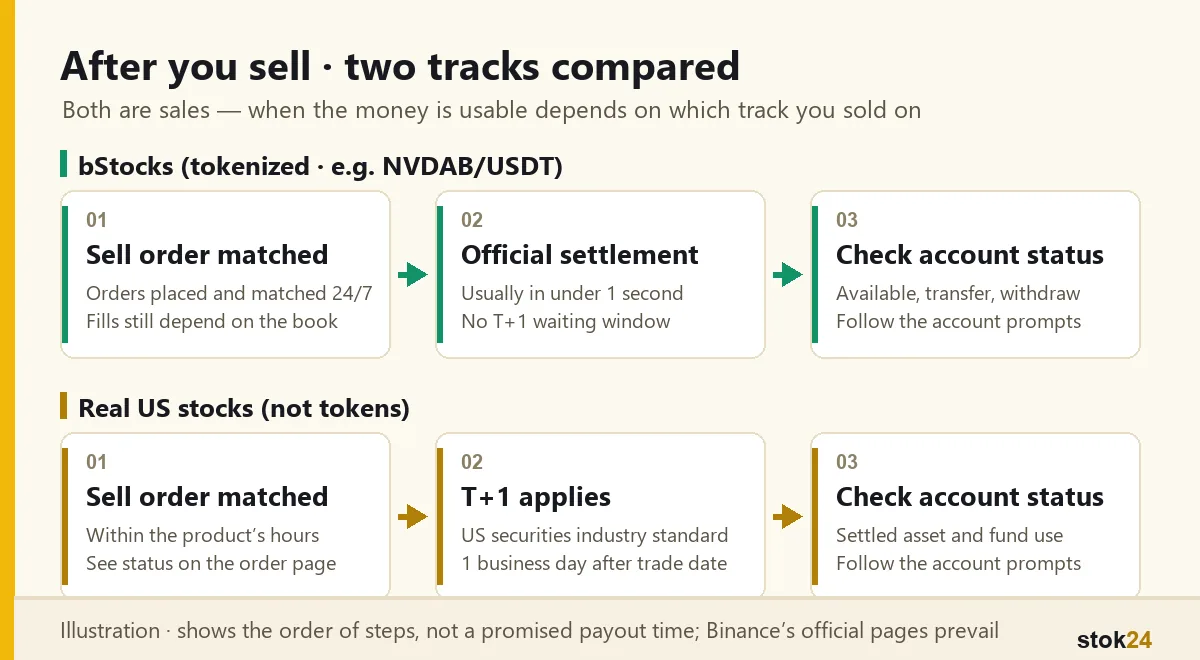
Selling a bStock on Spot
bStocks trade on Spot 24/7, weekends and US holidays included, and the Academy guide says transactions settle in under a second. Proceeds come in the pair's quote asset, so selling on NVDAB/USDT gives you USDT.
The slow part is usually step one. Around the clock doesn't mean deep around the clock. The bStocks FAQ says market makers supply the liquidity, and when the US market is closed prices come from supply and demand on the exchange and can move away from the stock's last close. A market order on a thin weekend book can fill well below the last price. We would sell with a limit order outside US hours and accept that it may take a while to fill.
After the fill, the bStocks pages describe no separate hold on sale proceeds, and they don't promise there is never one. What they do describe are pauses: in the FAQ's table of typical corporate actions, deposits, withdrawals and conversion stop around dividends, and during a split Spot trading stops as well. Moving the USDT itself off the exchange follows the normal withdrawal rules for that asset, which these pages don't cover. If you are withdrawing the token rather than selling it, the Academy guide says only BNB Smart Chain is supported, a network fee applies and the minimum varies by token.
Selling a stock on Binance Stock Trading
Here the stock trading FAQ (updated 13 September 2026) sets out a slower chain.
- When it can fill. The service runs up to 24 hours a day, five days a week, with 24-hour trading only for selected stocks. A market order can be placed at any time but is only active during regular trading hours, 9:30 a.m. to 4:00 p.m. Eastern Time on US trading days; outside them it waits for the next open. It is closed from Friday 8 p.m. to Sunday 8 p.m. Eastern Time.
- Where the money lands. All stock sale proceeds are credited as USDC to your Funding Account.
- What you can do before settlement. Until settlement is complete, proceeds from a sell order "can only be used for spot, stock trading and earn subscriptions". Withdrawal isn't on that list.
- When settlement happens. The FAQ says settlement takes place on the next settlement cycle, which "may fall in the range of T+1 trading day". The settlement date is shown on your order detail page, and funds awaiting settlement appear on the asset detail page.
T+1 is the US market standard. The SEC's investor bulletin says the standard US settlement cycle moved to T+1, one business day after the trade date, on 28 May 2024.
| bStock sold on Spot | Stock sold on the stock service | |
|---|---|---|
| When a sale can fill | 24/7 | Market orders in regular US hours; limit orders in the sessions you choose |
| Settlement | Usually under a second | Next settlement cycle, in the range of T+1 |
| Proceeds arrive as | The pair's quote asset, such as USDT | USDC in your Funding Account |
| Before settlement | Not applicable | Only for spot, stock trading and earn subscriptions |
A worked case, with dates of our own choosing: sell a stock at 2:00 p.m. Eastern Time on a Friday that is a normal US trading day. T+1 lands on Monday, the next business day. Over the weekend the USDC can go into another trade but not off the platform. The order detail page shows the date to watch.
A weekend exit, and its catches
If you hold the stock and want out on a Saturday, the pages we read allow a two-step route in principle. The Academy guide says conversion from stock to bStock is generally available 24/7, and the bStock then trades on Spot 24/7. Convert, then sell.
The catches are real. Conversion pauses for corporate actions and maintenance. The weekend price of the bStock comes from the Spot order book and can sit at a discount to Friday's close. And the pages don't say whether a stock position bought recently, whose purchase hasn't settled yet, can be converted. We would check the [Token Conversion] screen on a quiet day before relying on this route when it matters.
The money isn't where you expected
Work through it in the order the money moves:
- Is the order filled? Check the order status. Partially filled or open means part or all of the position is still yours.
- Which asset and which account? A bStock sale pays the quote asset into Spot. A stock sale pays USDC into Funding.
- Settled yet? For a stock, look at the settlement date on the order detail page and the pending funds on the asset detail page.
- Is something paused? Look for an announcement about a dividend, split or maintenance on that asset.
If all four check out and the money still isn't there, contact customer support with the order ID and time. For how the costs of the sale add up, see what a US stock trade on Binance costs.
Sources, read 26 September 2026: Binance Academy, What Are bStocks? (updated 29 June 2026); Binance, Frequently Asked Questions on bStocks (updated 28 July 2026); Binance, What Is Binance Stock Trading and How to Trade Stocks on Binance? (updated 13 September 2026); SEC investor bulletin on T+1. Also read: the announcement Introducing bStocks (updated 10 July 2026). The Friday example is ours, and a US market holiday in the middle would push its settlement date back.