Stock splits and bStocks: your balance, the price and your open orders
1 × $100 = 10 × $10. That line is the whole arithmetic of a 10-for-1 split: ten times the tokens at a tenth of the price, the same $100. For a bStock the Multiplier does this for you, and you don't sign or confirm anything. The parts that need your attention are around it: Spot trading is typically paused while the split is processed, an outside wallet may keep showing the old number, and orders placed at pre-split prices may no longer make sense.
Facts here come from Binance's bStocks FAQ and Academy guide, and for comparison the corporate actions FAQ for Binance's stock trading service, all read in English on 26 September 2026.
Forward and reverse splits, in numbers
A company splits its stock when the price per share has climbed high, and reverse-splits when it has fallen low; the bStocks FAQ describes both that way. It compares a split to a change in a token's denomination: the total value stays put while the number of units and the price per unit move in opposite directions.
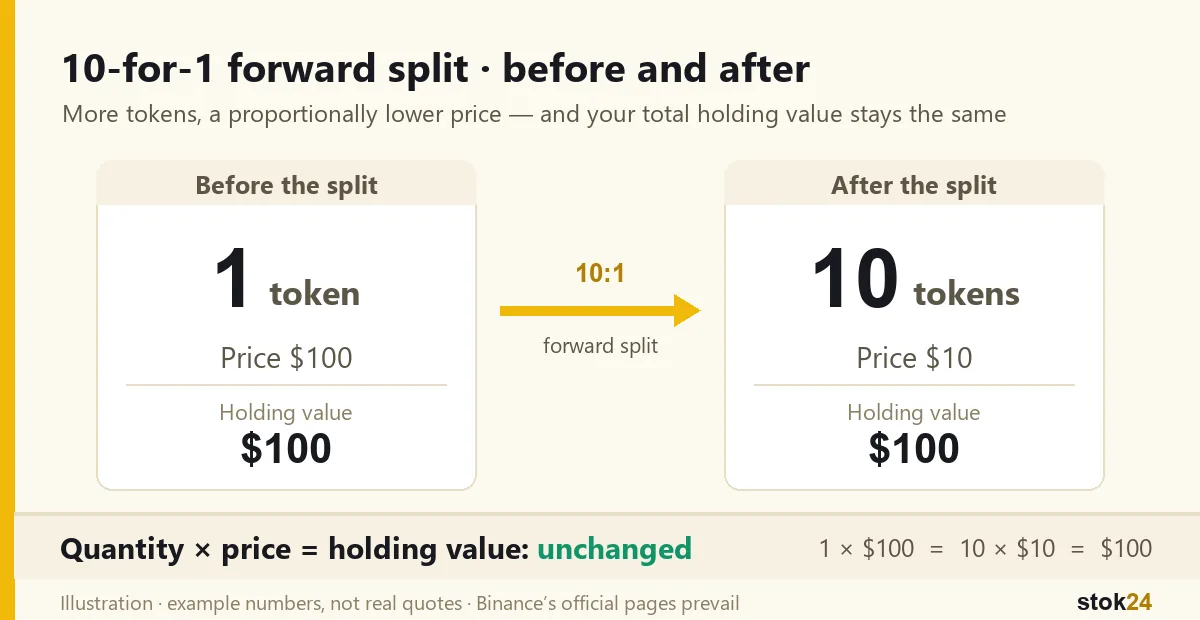
Binance's own examples, all labelled illustrative:
| Example | Before | After |
|---|---|---|
| NVDA 10-for-1 split (FAQ) | 1 share at $1,200 | 10 shares at $120; bStock Multiplier up 10 times |
| 2-for-1 split on 10 TSLAB (FAQ) | 10 TSLAB at $250, $2,500 | 20 TSLAB at $125, $2,500 |
| 1-for-10 reverse split (FAQ) | 100 shares at $0.50, $50 | 10 shares at $5.00, $50 |
The notation is easy to read backwards. "10-for-1" or "10:1" means one old unit becomes ten. "1-for-10" is the reverse: ten old units become one. In either case, if count × price after the split doesn't roughly equal count × price before it, something other than the split has happened, most likely an ordinary price move.
A split doesn't change the value of the company or your slice of it, and it doesn't make a stock cheap in any sense that matters. A reverse split usually follows a long fall in the share price, which is worth knowing about the company, though the reverse split itself costs you nothing.
How the Multiplier shows up
For bStocks the split runs through the Multiplier, the same mechanism that handles dividends. In the FAQ's words, if NVDA does a 10:1 split "your Multiplier increases by 10x, your displayed balance goes from 1 to 10, each now priced at 1/10th." A reverse split moves it the other way.
The raw on-chain balance, the number the token contract stores, doesn't change. The FAQ's 2-for-1 example shows an external wallet holding "10 raw (multiplier: 2.0) = effective: 20", while the Binance account shows 20 TSLAB. Binance always shows the multiplied amount, and so does BscScan, which supports BEP-677 (Scaled UI Amount) natively. A wallet that hasn't integrated BEP-677 may keep showing 10. Nothing has been lost; that wallet just isn't applying the Multiplier.
If your bStocks sit in a DeFi protocol, the FAQ doesn't say how any given protocol reads the balance. We would check how that protocol displays the position after a split before doing anything with it.
Rounding can touch the last decimal. The FAQ says the adjusted balance is subject to rounding, timing, operational limits and the legal documents, and bStocks carry up to 8 decimal places. Among the ways the issuer may reflect corporate actions in general, the FAQ also lists cash-in-lieu, without tying it to splits.
What stops while it's processed
Splits pause more than dividends do. The FAQ's table of typical corporate actions:
| Event | Deposits, withdrawals, conversion | Spot trading |
|---|---|---|
| Dividend reinvestment (ex-date) | Paused | Available |
| Stock split | Paused | Paused |
| Reverse split | Paused | Paused |
The Academy guide says Spot trading is generally not suspended for dividend processing. That sentence is about dividends only, and the FAQ's table shows the opposite for splits. So during a typical split, going by that table, you can't sell the bStock on Spot, move it on or off Binance, or convert it into the stock. Services come back once processing, reconciliation and controls are complete, and the FAQ doesn't give a typical duration.
On notice, the two pages differ in tone. The Academy guide says users receive advance notice in the app. The FAQ says notice comes "where practicable" and that "Advance notice is not guaranteed in all circumstances". The dividend notice we read in full gave exact UTC times for every pause. The announcement list we scanned on 26 September 2026 had no split notice for a bStock, so we can't say how much warning one gives.
Your open orders
This is the gap in the bStocks documentation. Neither the FAQ nor the Academy guide says what happens to an open Spot order on a bStock when trading pauses for a split: whether it is cancelled, kept or adjusted. A limit order to sell 1 token at $110, left standing through a 10-for-1 split, would sit at about eleven times the new price of around $10 if it survived unchanged. We would cancel open orders on that bStock before the pause and place new ones at post-split prices once trading resumes.
For comparison, the stock side has written rules. The corporate actions FAQ for Binance Stock Trading says pending orders on an affected stock may be cancelled once a mandatory corporate action is notified, and then:
- Reverse split: all GTC orders with a trade date before the effective date are cancelled.
- Forward split: GTC buy limit orders are adjusted rather than cancelled. Its example is an order to buy 5 shares at $400 before a 4-for-1 split becoming 20 shares at $100, still $2,000 in total. Other order types may not be adjusted.
- GTC orders placed in the overnight session are cancelled before a corporate action event.
Those rules belong to Binance Stock Trading. Don't assume they carry over to bStock orders on Spot.
A short check once it's done
- Multiply the new count by the new price. It should come close to the old count times the old price, give or take market movement since.
- Open your order list and delete or redo anything priced for the old share count.
- If you keep records of what you paid, divide your cost per token by the split ratio: $250 a token before a 2-for-1 split is $125 a token after it.
- If the tokens are in an outside wallet that still shows the old number, check the balance on BscScan, which applies the Multiplier.
Dividends run through the same mechanism with a smaller effect; see how bStock dividends work. For events the FAQ lists but doesn't explain case by case, such as delistings and mergers, see halts and delistings.
Sources, read 26 September 2026: Binance, Frequently Asked Questions on bStocks (updated 28 July 2026); Binance Academy, What Are bStocks? (updated 29 June 2026); Binance Stocks Trading Corporate Actions (updated 2 June 2026). Also read: Binance's announcement list and the NVDA and WDC dividend notice of 4 September 2026. The $110 order and the cost-per-token line are our examples.